
Views: 3 Author: Site Editor Publish Time: 2026-10-24 Origin: Site

Do not sign off a playground project on installation day alone. A proper handover requires a documented acceptance check against the approved drawings, the third-party test report, and the surfacing specification, followed by a written defect list, a defects liability period, and an operator training record. Most disputes on playground projects are not about the equipment quality itself; they are about what was agreed as complete and what was left open. The handover file is the document that settles both. It should contain the as-built drawing, the certificate issued for the installed models, the fall height of every play element, the measured depth of the impact-absorbing surfacing, the foundation and anchor record, the maintenance manual, the spare parts list, and a signed defect list with a date for closure of each item.
This guide explains what a handover inspection actually checks, how the acceptance test is structured, how to write a defect list that holds up, what belongs in the defects liability period, and how to verify the certificate that arrives with the equipment. It is written for the buyer who has already chosen the equipment and now has to confirm that what is standing on the site is what was ordered.
Quick Answer
1. What Playground Project Handover Actually Covers
2. The Four Documents That Must Arrive With the Equipment
3. How the Site Acceptance Inspection Is Structured
4. Checking Foundations, Anchors and Structural Connections
5. Verifying Fall Height and Impact-Attenuating Surfacing
6. Writing a Defect List That Holds Up
7. The Defects Liability Period and How to Run It
8. Operator Training and the Maintenance Handover
9. Frequently Asked Questions
10. Common Mistakes to Avoid
11. Buyer Checklist
12. Final Thoughts
Handover is the point where the construction obligation ends and the operating obligation begins. It is a legal transfer of responsibility, and it only works if two documents are produced: a record of what was accepted, and a list of what was not. Anything installed and paid for but not recorded becomes invisible six months later, and the first equipment failure then turns into a dispute about who was responsible for what.
The handover file normally has five parts. The first is the as-built drawing set, which shows what was actually installed rather than what was proposed. The second is the compliance evidence, which is the third-party test report for the models on site and any site-specific inspection certificate required by the receiving authority. The third is the safety verification record, which states the fall height of each play element and the measured thickness of the impact-absorbing surfacing below it. The fourth is the operating file, which is the maintenance manual, the inspection intervals, and the spare parts list. The fifth is the defect list with the dates by which each item must be closed.
A buyer who receives only the first part, an as-built drawing, has received about a fifth of what is needed. The most common failure in practice is the missing safety verification record, because the fall height is often measured on site by the installer rather than taken from the drawings, and nobody reconciles the two. When a surfacing contractor and an equipment installer are separate companies, that gap is where an entire fall zone can end up outside the specification.
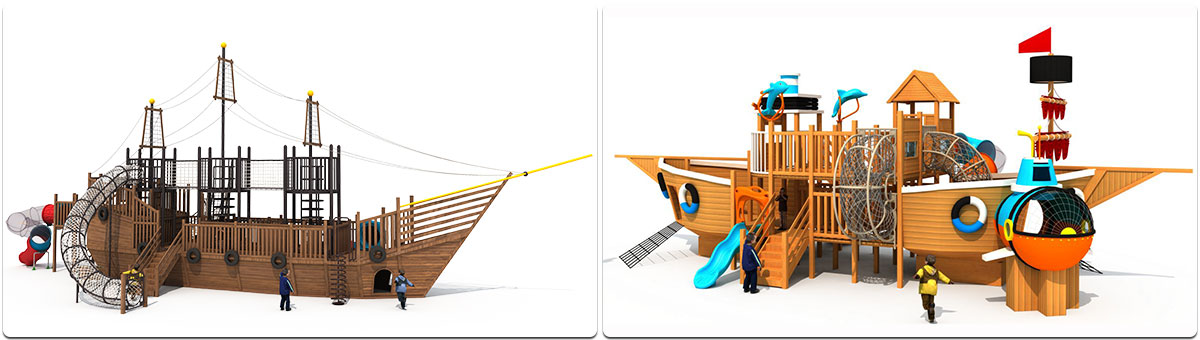
Product reference from the NUUTOO project library.
Four documents should be handed over with the equipment, and each one answers a different question that a buyer will be asked later. The as-built drawing answers what is installed and where. The third-party test report answers whether the named models meet the safety standard. The maintenance manual answers how the equipment is inspected and serviced. The spare parts list answers what it costs to keep it running.
The test report is the document most often accepted on trust, and it should not be. A type examination certificate covers one product against one named standard, so the check is whether the model names printed on the certificate match the model names on the as-built drawing. A report issued for a sliding pole does not cover a spiral slide, and a report issued for a rope net tower does not cover a combination unit that includes a slide. Where the site has a mixed layout, the buyer should expect more than one certificate and should map each certificate to each equipment group.
The maintenance manual should state the inspection intervals in a form the operator can follow without a specialist, because most operators are not playground technicians. It should also state the fastener check interval, the wear part replacement interval, and the surfacing maintenance requirement. A manual that only contains exploded drawings and assembly instructions is an installation document, not a maintenance document, and it does not close the handover.
The spare parts list matters more than buyers expect, because it is the document that converts the equipment into a maintainable asset. It should name each wear item, its drawing reference, and its price basis, and it should state whether the supplier holds the tooling to reproduce a net or a seat three years after delivery. The wider question of how to verify a supplier before ordering is covered in our commercial playground equipment manufacturer selection guide.
An acceptance inspection runs against a fixed reference, not against an impression. The reference is the approved layout drawing with the fall heights marked on it, and the inspection is a sequence of physical checks rather than a walk-around. The practical structure used on public projects has five stages: verify identity, verify geometry, verify safety, verify documents, and verify the operating file.
Identity comes first, and it is a check against the certificate rather than against the catalogue. Every equipment group on site is matched to a model reference, and every model reference is matched to a line on a certificate. If a group on site has no matching certificate line, that group is not accepted regardless of how it looks, and the issue is escalated the same day rather than carried into the defect list.
Geometry covers the measurable dimensions: overall footprint, platform heights, slide exit heights, the free space around each item, and the distance between moving elements. Each figure is measured with a tape and compared to the drawing, and the tolerance is agreed in advance rather than debated at the inspection. A commonly used working tolerance is plus or minus 10 mm on installed heights, because fabrication and site setting out always differ slightly, but the tolerance has to be written into the contract to be enforceable.
Safety covers the surfacing, the moving parts, the entrapment openings, the fasteners and the finish. Documents cover the certificate set, the operation manual and the spare parts list. The operating file covers the training record and the maintenance schedule. A buyer who skips straight to a visual walk-around is checking the least important of these five stages, because a well-made piece of equipment that is installed at the wrong height or on the wrong surface fails regardless of its build quality.
| Stage | What is checked | Reference document | Recorded as |
|---|---|---|---|
| Identity | Every equipment group matched to a certified model | Third-party test report | Model list with certificate numbers |
| Geometry | Platform height, slide exit height, free space, element spacing | Approved layout drawing | Measured dimension sheet |
| Safety | Surfacing depth, entrapment openings, fasteners, finish | EN 1176 and EN 1177 requirements | Surfacing measurement record |
| Documents | Certificate set, operation manual, spare parts list | Contract schedule of documents | Document handover register |
| Operating file | Operator training delivered, schedule issued | Maintenance plan in the contract | Training record and schedule |
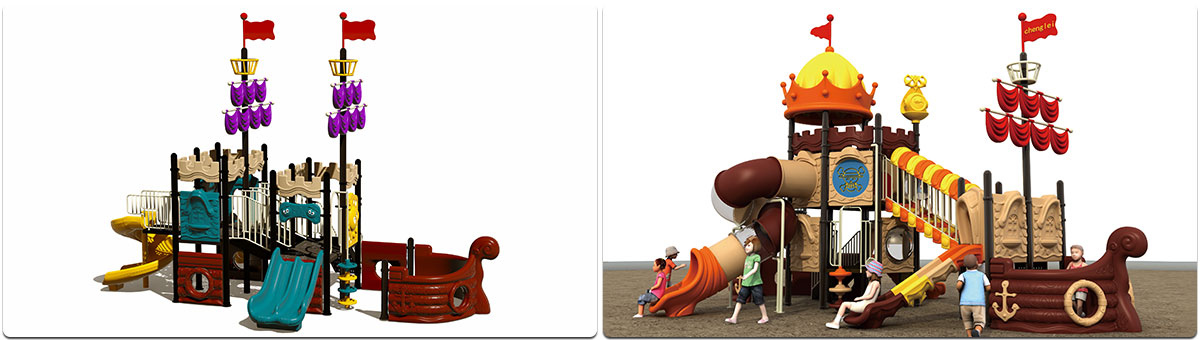
Product reference from the NUUTOO project library.
Yes, foundations are inspected, and the inspection is where the hidden part of the project either passes or fails. Foundations are covered once the surfacing is laid, which is why the record has to be captured during installation rather than reconstructed afterwards. The standard requirement on a public playground is that foundations are concealed and that the structure remains stable under the foreseeable loads, so what is inspected is the evidence of how the anchorage was built, not the concrete itself.
The evidence consists of the foundation and anchor record, which for each post states the embedment depth, the anchor type, the concrete grade and the pour date, together with a photograph taken before the concrete was placed. That photograph is the single most useful item in the file, because it is the only thing that proves a post was embedded to the specified depth. Without it, a buried anchor cannot be verified at any later point, and the only remaining option is a destructive test.
Two further checks are made on the connections. The first is the tightening of the anchor bolts and the fixing of the base plate, which is normally recorded by the installer as a torque value or a check list. The second is the coating damage check at the point where the steel enters the concrete or the ground, because galvanising that is cut during site drilling is the single most common source of early rust failure on a well-built frame. Any cut made on site after galvanising has to be repaired with a zinc-rich touch-up compound, and the repair should be visible in the handover photographs.
The buyer should also confirm that the ground conditions assumed in the foundation design match the site. Where the supplier designed for a standard soil class and the actual site is fill or made ground, the embedment depth has to be increased, and that change is a design change. It should be recorded as a variation with a date, not absorbed silently by the installer, and the same applies where a foundation is omitted because the installer judged the post to be self-supporting.
Yes, this is the most safety-critical measurement in the handover, and it is the one most often left out. The fall height is the vertical distance from the highest intended play surface to the impact-absorbing surfacing below it, measured in the position a child would actually be in, which for a slide is the seat position and for a climbing frame is the standing platform rather than the handhold. Once the fall height is known, the required thickness of the surfacing follows from the critical height of fall table under EN 1177, and a thickness that is 20 mm short is a non-conformance even though it may look adequate on the day.
The verification is done by physical measurement of the laid surfacing at defined points, not by reading the invoice. For poured rubber, the measurement is a core sample taken through the full thickness at the deepest point of the lay, and for tile or modular systems the measurement is the combined thickness of the tile plus any rubber below it, checked at the joint. Three points are normally sufficient on a uniform single-layer installation, and more are taken where the specification changes depth across the fall zone.
Two points about surfacing are routinely misunderstood at handover. The first is that the impact attenuation performance is a property of the installed system, not of the material alone, and it is normally verified in the laboratory against the declared critical fall height. The second is that loose-fill surfaces such as wood chip or sand change depth through use, so the handover record should state the installed depth and the minimum depth to be maintained, with a marker or a depth gauge left on site for the operator. A record that states only the material name is not a record of compliance, and the same applies to a surface installed in a fall zone for equipment with a higher fall height elsewhere on the same structure.
A defect list is a list of specific, closable items, not a general statement of dissatisfaction. Each entry needs four things: what is wrong, where it is, what standard it fails, and what closing it would mean. A useful entry reads as follows: the upper handrail on the climbing frame in group B has a gap of 14 mm against the 12 mm maximum, photographed with a reference scale, and closing it means replacing the handrail section with the certified part and re-checking the coating at the joint.
Each defect is graded so that the priority is visible. A safety non-conformance, which is a failure against a requirement in EN 1176 or EN 1177, is closed before the site opens to the public, because the area cannot be used until it is. A functional non-conformance, such as a slide exit discharging onto a hard surface instead of the surfacing, is also closed before opening. A cosmetic item, such as a scratched coating panel or a misaligned nameplate, is scheduled for correction within the defects liability period.
The list should record photographs with a scale reference and the date of each entry, and it should be signed by both parties. Photographs matter more than descriptions because the coating repair, the handrail gap and the surfacing depth can each be argued about in words for months. Where a defect cannot be closed on site, for example a damaged certified component that must be replaced, the site is kept closed in the affected area and the replacement is tracked as an open item against the delivery date.
A final point on the defect list is to record what was checked and found acceptable, not only what was not. A handover file that lists four defects and nothing else leaves the reader unable to tell whether the remaining checks were performed and passed, or simply never done. Recording passed stages against the acceptance checklist closes that gap and is what allows the file to be relied on in a later claim or insurance question.
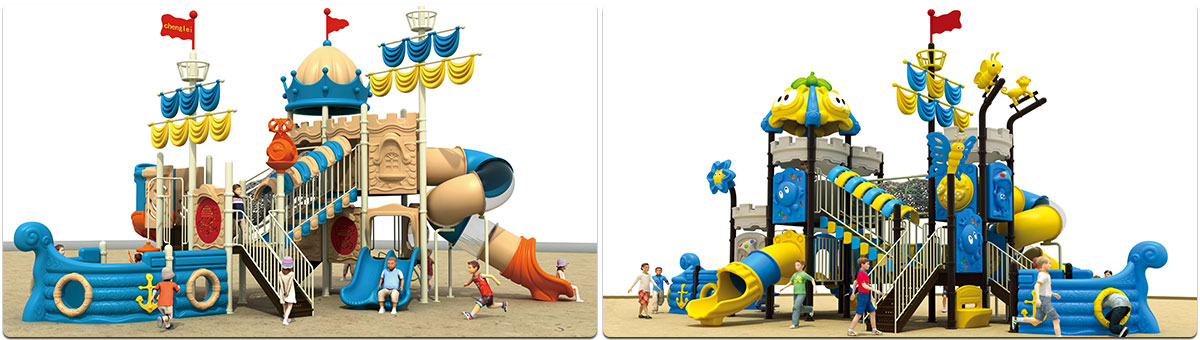
Product reference from the NUUTOO project library.
A defects liability period is the window after handover during which the contractor remains responsible for defects in the works. For playground equipment the usual arrangement is a period of three to twelve months, and it covers the failure of structural components, the coating system and the workmanship of the installation, while excluding normal wear, damage caused by misuse, and damage caused by the absence of the agreed maintenance.
The period is only useful if it is actively managed. The buyer should hold a scheduled inspection inside the period, typically at month six, with the operator present, and use it to check the items most likely to have moved or worn: fastener torque, chain and bearing wear, rope tension, surfacing depth at the deepest point of each fall zone, and coating condition at the ground line. The same inspection is used to confirm that the operator has followed the maintenance schedule, because a maintenance failure is a legitimate exclusion and it must be documented to be relied on.
Two contract terms make this workable. The first is a defined response time for a defect raised during the period, which is normally stated in days rather than left open. The second is a document retention obligation, requiring the contractor to keep the tooling, the drawings and the spare part references for the duration of the period and for a stated interval afterwards, because a replacement part made five years later has to match the equipment that is on the ground. Both terms should be agreed before the order is placed, not during the first defect.
It is worth noting that the handover file and the defects liability period work as one system. The file establishes what was accepted, and the period establishes what happens to it afterwards. A project with a detailed handover and no structured period will still generate disputes, because nothing prompts either party to return to the site while the failure is still a manufacturing or workmanship problem rather than a wear problem.
Yes, operator training should be part of the handover, and it should be recorded. The training is normally a half-day session on site for the staff who will run the play area, and it has three parts: the daily visual check, the periodic documented check, and the reporting route for a defect. The value of the session is mostly in the reporting route, because a defect reported late is a defect that has already been used.
The daily visual check is a walk of the area looking for what a child would notice: damaged surfacing, loose or missing fasteners, a broken or frayed rope, a sharp edge, standing water, and litter. It takes about ten minutes for a typical play area and it does not require any special equipment. The periodic check is a documented inspection at the interval stated in the maintenance manual, carried out by a competent person and written down. The reporting route names a person and a method, so that a defect reaches the contractor in a form that can be actioned, with a photograph and a location.
The maintenance handover also transfers the responsibility for the surfacing, which is frequently overlooked because it is installed by a different company. The operator needs to know which material was laid, what its critical fall height is, what depth is required, how it is maintained, and how it is repaired locally if it is damaged. That last point decides whether a small impact area becomes a safety closure, and the answer should be in the file rather than discovered during an incident.
Recording the training is a short matter: date, attendees by name and role, the topics covered, and the maintenance schedule issued. That record is the evidence that the operating obligation transferred with the equipment, and it is also what allows the contractor to rely on a maintenance exclusion later. The wider question of how a surfacing specification should be written is covered in our playground surfacing selection guide.
No, not if a safety non-conformance is still open. The site may open once the safety and functional checks are closed and the defect list has been signed, with the remaining cosmetic items scheduled inside the defects liability period. Opening a site while an open safety item exists transfers that risk to the operator, and on a public play area that decision is normally made by the owner in writing rather than by the installer on site.
Yes, it should be part of the handover document set, and it should be requested at the quotation stage so that the model names can be verified before the order is placed. Where the supplier declines to provide the report for the delivered models, the buyer should treat that as a non-conformance and hold the payment until the document is produced. A general company certificate is not a substitute, because it proves a management system rather than a product.
Not necessarily the supplier. Under EN 1176 the annual inspection is carried out by a competent inspector, and on a public site this is usually appointed by the owner rather than the manufacturer. What the supplier can supply is the reference information the inspector needs, namely the installation date, the model references, the fall heights, the surfacing specification and the maintenance record, and that reference information should be handed over as part of the operating file.
It depends on the contract and on the environment, and the common arrangements are three months, six months or twelve months. A period of twelve months is more meaningful in a coastal or high humidity climate, where coating and corrosion problems appear early, while three months is often enough for a coated steel structure in a dry inland location. The period should be agreed before the order is placed and it should be tied to the first annual inspection so that the two do not drift apart.
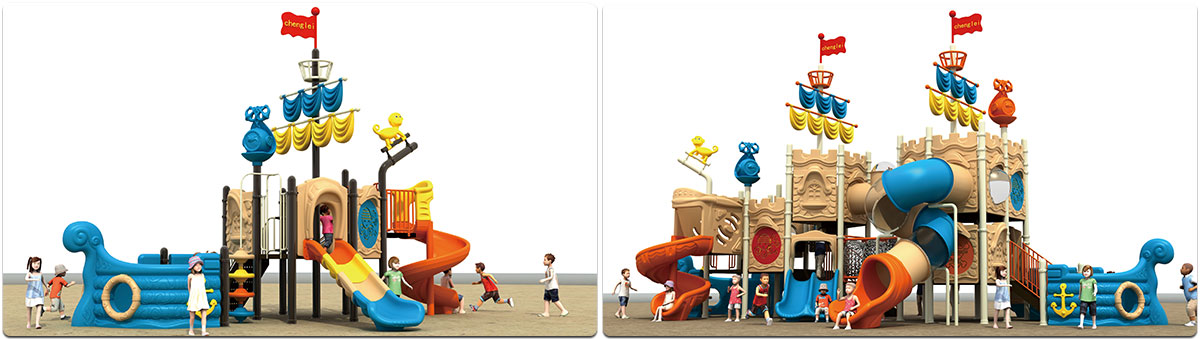
Product reference from the NUUTOO project library.
The first common mistake is accepting a verbal handover. A handover that happens on site with no file produced leaves no record of what was agreed, and it is the point at which responsibility for the operating side quietly transfers without anyone noting it. The second is signing the acceptance certificate before the surfacing measurement is taken, because the surfacing is the last item installed and the only item that cannot be re-checked later without digging.
The third mistake is accepting one certificate for the whole site. A certificate covers the models named on it, so a site with five equipment groups will normally need several certificates, and the mapping between groups and certificates should be written into the handover file. The fourth is not checking the fall heights against the drawings, which is the classic cause of a non-conformance discovered at the first annual inspection, when the surfacing can no longer be changed without rebuilding the fall zone.
The fifth is a defect list written as a complaint rather than as a schedule. Items phrased as concerns cannot be closed, because there is no definition of done. The sixth is leaving the operator training undocumented, which removes the ability to rely on a maintenance exclusion later. The seventh is omitting the spare parts list from the handover, which is the point at which the equipment becomes expensive to keep, because nothing can be ordered against a reference.
Product reference from the NUUTOO project library.
As-built drawing set received, showing installed positions and fall heights
Third-party test report for every model on site, matched group by group
Measured platform heights, slide exit heights and free space, within agreed tolerance
Surfacing depth measured at defined points and recorded against the required thickness
Foundation and anchor record with embedment depth, concrete grade and pre-pour photographs
Site-applied coating damage checked and zinc-rich touch-up confirmed
Defect list signed, photographed with scale, and graded by safety and functional priority
Defects liability period length and contractor response time written into the contract
Operator training delivered and recorded with attendee names and roles
Maintenance manual, inspection intervals and spare parts list handed over and signed for
A handover is judged by what it prevents, and the two problems it prevents are an unsafe play area opening to the public and an unmaintained equipment asset that nobody can keep running. The first is prevented by the geometric and surfacing verification, and the second by the operating file. Both are cheap to produce during installation and expensive to reconstruct afterwards.
The practical advice is to fix the reference before the site work starts: the approved drawing with fall heights, the list of certified models, the agreed measurement tolerance, the required surfacing thickness, and the document list that must arrive with the equipment. Once those five things are written down, the inspection on the final day is a short verification rather than an argument, and the file that comes out of it is evidence rather than paperwork. For a buyer still comparing options, the same principle applies earlier in the process, since a supplier who provides a clear reference set before the order is usually a supplier who can provide it at handover. The background on comparing those suppliers is set out in our playground equipment overview, and the pre-order document check is covered in our custom playground equipment guide.
 English