Views: 11 Author: Site Editor Publish Time: 2026-10-20 Origin: Site
Playground equipment ships as disassembled components, not as assembled play structures, and it is loaded into standard shipping containers measured in cubic metres (CBM). A single 40-foot high-cube container (40HQ) holds 76.4CBM, which typically carries one complete medium-sized play zone weighing 3,000 to 5,000kg. Delivery time from a Chinese factory to a European or North American port runs 28 to 40 days by sea. Most projects need one 40HQ for a 400 to 600m² outdoor play area.
This guide explains how to calculate how many containers your project needs, which components arrive loose versus welded, what documentation the buyer receives, and how to check the equipment on arrival.
Quick Answer
Container Basics Every Buyer Should Know
How to Calculate Containers for Your Project
What Ships Loose and What Ships Welded
Lead Time and Delivery Windows
Documents the Buyer Receives
Common Mistakes to Avoid
Frequently Asked Questions
Buyer Checklist
Final Thoughts
A shipping container, called a box or intermodal container, is a steel freight box in fixed ISO sizes. Containers are the unit of sea freight. Full Container Load (FCL) means one container belongs to one shipment. Less than Container Load (LCL) means several buyers share one container, and the cargo is delivered to a warehouse at the destination instead of straight to your site.
Three sizes cover almost all playground equipment shipments:
20GP (20-foot general purpose) — 33.2CBM internal, door opening 2.34m wide by 2.39m high. Used for slides, panels and accessories.
40GP (40-foot general purpose) — 67.7CBM internal, same door size as 20GP. Used for post sets, decks and roofs.
40HQ (40-foot high cube) — 76.4CBM internal, door opening 2.34m wide by 2.70m high. The standard choice for a full project because the extra 300mm of door height takes assembled slide sections and tower frames.
| Container | Typical use | Internal volume (CBM) |
|---|---|---|
| 20GP | Slides, panels and small accessories. Confirm the 2.34 m door width first. | 33.2 |
| 40GP | Post sets, decks and roofs. Same door size as 20GP. | 67.7 |
| 40HQ | Full projects with assembled tower frames. The extra 300 mm door height takes welded frames. | 76.4 |
| LCL | Part loads shared between buyers. Delivered to a warehouse, not your site. | Varies |
| Bulk / flat pack | High-volume projects where the buyer holds local assembly capability. | By agreement |
CBM is the volume measurement. One CBM equals one cubic metre, which is 35.31 cubic feet. Shipping is charged on the greater of volume (CBM) or weight (tonnes), so a bulky play structure with little steel still costs money by volume.
Calculate the required container count from the packed volume of each component, not from the assembled footprint of the play zone. A 20m×12m assembled play structure may occupy only 240m² of ground but pack down to around 55CBM, which fills roughly three quarters of one 40HQ.
The working formula is:
Containers = total packed volume (CBM) ÷ 76.4×0.85
The 0.85 factor accounts for void space inside the container that cannot be filled because components are rectangular and the container is not. Applying an 85% packing efficiency is standard practice and prevents an under-order that leaves part of the equipment on a second shipment.
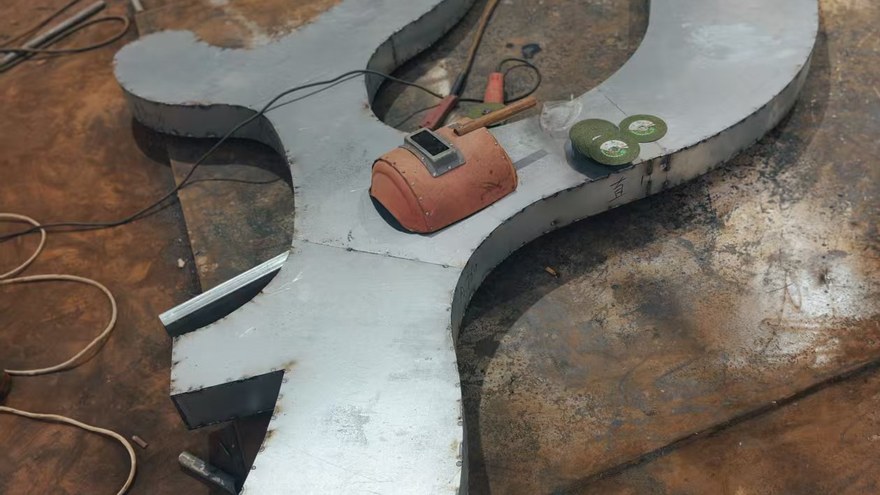
Concept illustration: steel plate cut and prepared for playground component fabrication. AI-generated; not a completed NUUTOO project or construction drawing.
As a check, a well-packed 40HQ typically carries 3,000 to 5,000kg of galvanised steel playground equipment. If your packing list shows more than 5,000kg per container, the weight, not the volume, will decide the freight cost and you should consider two 40HQ instead of one.
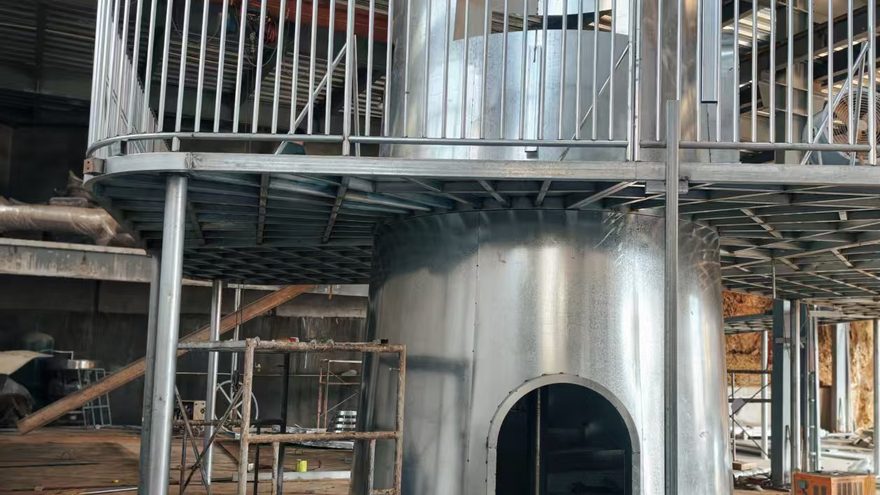
Structural steel arrives as separate factory-welded modules bolted together on site. This is not a shortcut; it is how the equipment fits through a container door and how it is replaced if one part is damaged in transit. Tower frames typically arrive as one welded frame 2.0 to 2.4m tall, which is why the 40HQ door height of 2.70m matters.
Concept illustration: welded steel tower frame with railed platform prepared for container packing. AI-generated; not a completed NUUTOO project or construction drawing.
Plastic components such as roofs, slides and panels are moulded polyethylene or LLDPE parts. Slides arrive in sections 2 to 3m long, then joined on site with stainless steel or galvanised bolts. Posts arrive as either round tube sections or square tube with base plates already welded and drilled.
Playground surfacing, whether poured rubber or interlocking EPDM tiles, is almost never shipped in the equipment container. It travels separately, on a pallet or in bulk bags, because it would take more container volume than the equipment itself. Order it from a local supplier near the project site, or budget a separate freight line for it.
Standard stock-model equipment ships 15 to 25 days after the order deposit arrives. Custom equipment takes 30 to 45 days in production, then 28 to 40 days by sea. Total elapsed time from deposit to arrival at your port is therefore 45 to 80days, and the port-to-site leg adds a further 3 to 10 days inland.
Peak season is March to June for Northern Hemisphere projects. Booked production slots fill about four months ahead, so a project that must open before September needs a confirmed slot in April. Chinese New Year, normally in late January or February, closes factories for two to three weeks and is not counted in production days.
Incoterms decide who carries which cost. Under FOB (Free On Board) the seller delivers to the origin port and the buyer arranges main freight. Under CIF (Cost, Insurance and Freight) the seller pays sea freight and minimum insurance. Under DDP the seller delivers to your door, which is convenient but rarely the lowest-cost option for a full container of heavy steel.
Every shipment from a NUUTOO order ships with a commercial invoice, a packing list showing each component and its quantity, and a bill of lading or sea waybill. The commercial invoice states the contract value, the Incoterm and the currency. The packing list is the document to check on arrival, because it maps each line to a position number on the assembly drawing.
Equipment safety documentation depends on the destination market. EN 1176 is the European playground equipment standard and is the usual reference for European projects. ASTM F1487 and CSA Z614 cover North America. Ask for test reports issued by a laboratory accredited to ISO/IEC 17025, with the model number of your actual order on the report, not a generic company certificate.
Ask for the assembly drawing, the foundation plan and the parts list before shipment rather than after. The same coordination principle set out in our commercial playground manufacturer selection guide applies here: agree the document set before the deposit is paid, not after the container is booked. The assembly drawing lists the torque values for foundation bolts and the order in which towers must be erected, and it is the document your installer works from on site.
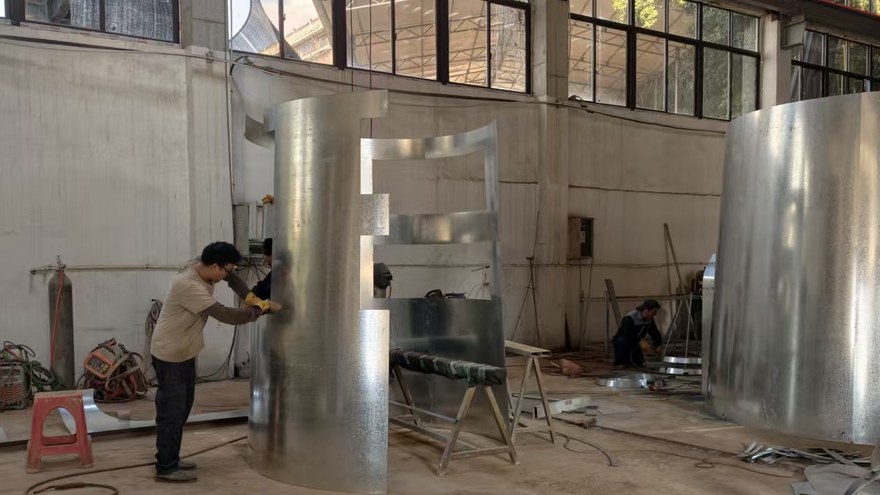
Concept illustration: roll bending of curved steel panels in a playground equipment workshop. AI-generated; not a completed NUUTOO project or construction drawing.
Ordering by assembled size instead of packed volume. This is the most common cause of a second, unexpected container and a second freight invoice.
Forgetting surfacing in the container. Impact-absorbing surfacing needs its own freight line, not a corner of the equipment container.
Not confirming the door opening. A 2.39m door rejects a 2.5m welded frame; check part height against door height before the frame is built.
Treating certification as a company badge. A certificate not listing your model number proves nothing about your order.
Leaving the site unprepared. Foundation curing needs time, so shipping and civil works must run in parallel, not in sequence.
Yes. One 40HQ normally covers a 400 to 600 m² outdoor play zone with slides, towers and an aerial walkway. Confirm with the packed volume on the packing list rather than the assembled area, because themed structures with high rooflines pack less densely.
Not for a full project. Air freight is possible for replacement parts and small components only. A 40HQ of steel equipment costs several times more by air, and air freight volume limits would split a project into dozens of separate shipments.
Yes, allow 30 to 45 days in production. Drawing approval itself needs 5 to 10 days, so the total from first enquiry to loading is usually 6 to 9 weeks.
No. Structural steel arrives as factory-welded modules bolted together on site. This is how the equipment fits through a container door and how a damaged part is replaced in transit.
Packing list total volume in CBM, converted at 76.4CBM per 40HQ with 85% packing efficiency
Component list separating structural steel, plastic parts, fixings and surfacing
Largest single part dimensions against the container door opening
Incoterm written on the commercial invoice, with the named port of departure and destination
EN 1176 or ASTM F1487 test report naming your model number
Assembly drawing, foundation plan and torque values supplied before loading
Surfacing ordered from a supplier near the site, on a separate delivery date
Production slot confirmed in writing before the deposit is paid
Shipping is an engineering task, not a logistics formality. Container volume, part height and door width determine whether a project fits in one shipment or two, and all three are decided before a single part is built. Verify the packed volume against ISO 668 container dimensions, verify the safety report against EN 1176 or ASTM F1487, and verify the packing list against the assembly drawing at the moment the container is opened.
Send your project location, target opening date and required models through the NUUTOO project enquiry page, and ask which documents will accompany the specific proposal.
 English